Grounded in experience. Connected to how places work.
OPEN / SPACE develops movement intelligence for complex environments. We bring together 25 years of team experience in pedestrian simulation, systems engineering and live monitoring to help organisations understand how people use their places and apply that understanding to improve them.
The experience behind OPEN / SPACE
Pedestrian simulation helps designers and operators test how spaces could perform under different conditions, exploring how people move, where congestion might develop, and how changes to layouts or operations could affect their experience.
Applying simulation across major infrastructure programmes revealed a further challenge: the understanding developed during design did not always carry through construction and into daily operation. Surveys captured particular moments. Models tested defined scenarios. Operators brought detailed knowledge of what happened on the ground. Each offered valuable evidence, but connecting them over time was difficult.
That challenge became particularly clear across complex transformation programmes, including London Bridge station in the UK. As the station changed through successive construction phases, so did the environment around passengers and staff. Understanding how people responded to those changes mattered both to the teams delivering the programme and to those keeping the station running.
OPEN / SPACE grew from that experience: a way to connect what we expect a place to do with how it actually performs, and to carry that learning into the next decision.
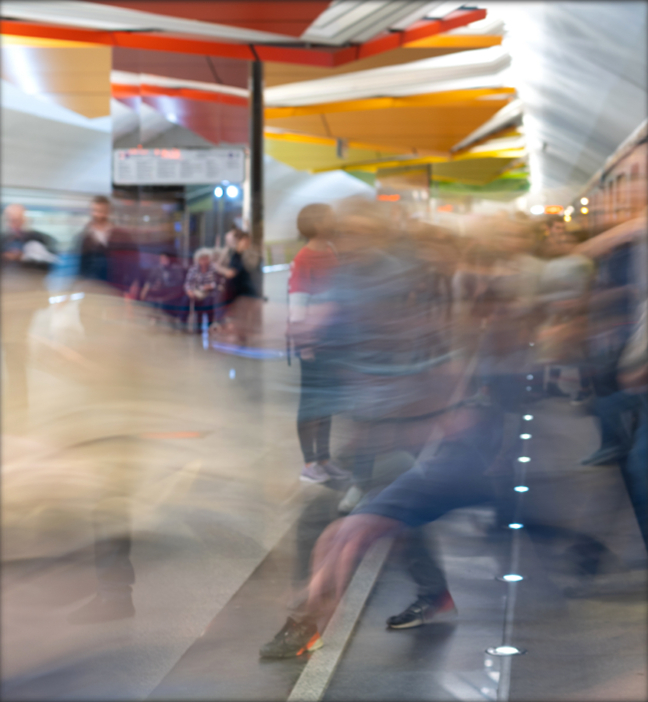
Connecting design with daily operation
OPEN / SPACE brings live and historical movement data, simulation outputs, spatial information and operational context together within permanent digital infrastructure.
This infrastructure provides a continuous understanding of how people use a physical environment. It supports daily management while giving organisations the evidence to assess performance, test proposed changes and improve how their buildings and spaces work over time.
Observed movement can inform simulation. Simulation can help assess changes to layouts, services or operating practices. Once a change is introduced, continued monitoring helps establish its effects. The same infrastructure supports this cycle as the environment and its use evolve.
Our work at London Euston has applied this approach to a busy operational station, connecting passenger movement monitoring with evidence for station management and planning.
Through a three-year research and development programme with Network Rail High Speed and London St. Pancras Highspeed, we developed and deployed movement intelligence across St Pancras, Stratford and Ebbsfleet International stations. The programme connected evidence across the three stations, examining the relationship between passenger demand, assets and facilities.
These experiences continue to shape the platform and how we deliver it: around the practical questions faced by the people responsible for an environment.

"The way people move is one of the clearest measures of whether a place is working. OPEN / SPACE was created to make that movement visible, measurable and connected to the decisions that shape the environment."
Dr Nicolas Le Glatin
Founder and CEO, OpenSpace Group
How we work
Each engagement starts with the purpose of the environment, the people who use it and the decisions the organisation needs to make. We work through the UtilitySpace Framework: a practical way to connect the value a place must create with the evidence needed to manage it, and a clear path from first insight to continuous improvement.
Value
Utility Triangle
Agree what the place needs to achieve across its layout, operation and the experience of the people using it.
Measure
Utility Twin
Use monitoring, analysis and simulation to establish performance, test change and understand the results.
Transform
Twin Maturity Model
Build the capability and shared working practices needed to turn evidence into continuous improvement.
The capability behind the framework
The UtilitySpace Framework brings together three complementary sources of expertise. OPEN / SPACE provides the platform and movement-intelligence method; clients and programme partners define the operational context and decisions that matter; technology and delivery partners provide the sensing and infrastructure needed to make the environment observable.
OPEN / SPACE
Movement intelligence platform and specialist expertise.
We configure the platform, define measurement needs and connect evidence to the decisions being addressed.
Clients and programme partners
Operational context and professional expertise.
Clients, designers, operators and advisers establish priorities, contribute domain knowledge and apply the evidence.
Technology and delivery partners
Sensing, integration and physical deployment.
Specialist partners support the infrastructure, connectivity and integration needed for the agreed application.
The delivery model is configured around the project, with clear responsibilities and scope to develop client and partner capability.
Our principles
Human experience
A place must work for the people who use it. We consider movement in relation to the environment's purpose, looking at how layout, information, services and operations affect people's experience.
People • Place • Experience
Ecosystem
Good decisions draw on different kinds of expertise. We bring clients, practitioners and technology partners together around shared evidence, with respect for the knowledge each contributes.
Expertise • Collaboration • Shared evidence
Curiosity
We ask questions, challenge assumptions and seek to understand how people experience the places they use. We learn from observation, from the people who use and operate those places, and from perspectives that challenge our own.
Observation • Learning • Adaptation
Innovation
We develop technology around practical needs. New capabilities are tested against evidence and shaped by their usefulness to the people designing, managing and operating real environments.
Purpose • Testing • Improvement
Put experience and evidence to work.
Discuss the place, project or service you want to improve.